Let’s talk teapots
Before I started playing with clay, I had no idea how complex making a teapot could be. I mean, aren’t teapots among the most ordinary of daily use objects?
When I told one of my first pottery teachers that I wanted to make a teapot by the end of the class, she let out a whoosh of breath and said, “Okay. So here are some things to practice.” And she put me to work making lidded pots and spout shaped bud vases, so I could master some skills before putting them all together to make a functional teapot.
The pot itself is fairly ordinary. But then there is the lid. It needs to fit–not too big, and not too small. So there are measurements, and rulers and calipers. And it should match the shape of the pot as well. It should, we hope, stay put when the pot is being poured, and that requires creating a gallery inside the pot, for the lid to sit in. So there is breath-holding, and hair pulling, and lots of failed attempts. It needs to be functional, but it would be nice if it’s also attractive. It can’t be too thin, or else it will crack. But you also don’t want it to be too thick and heavy, or it will weigh down the pot. There are uncountable ways to do it wrong.
And then there is the spout. I had no idea how complex a spout could be. Size, shape, angle, and point of attachment–they all matter, and they are all an opportunity to render the teapot a ruin. Place it too low, and the teapot doesn’t hold enough liquid. place it at the wrong angle, and the teapot drips or dribbles when it pours.
Then there is the drying. Ideally, the lid and the pot dry together, so that neither dries too quickly or becomes misshapen so they don’t match. At the same time, you don’t want them to be joined together when they are too wet, because the pieces could stick together. As i was putting my first teapot together, every day I was in the studio was a mix of excitement and terror–did it work? did I ruin it? was my pot still alive?
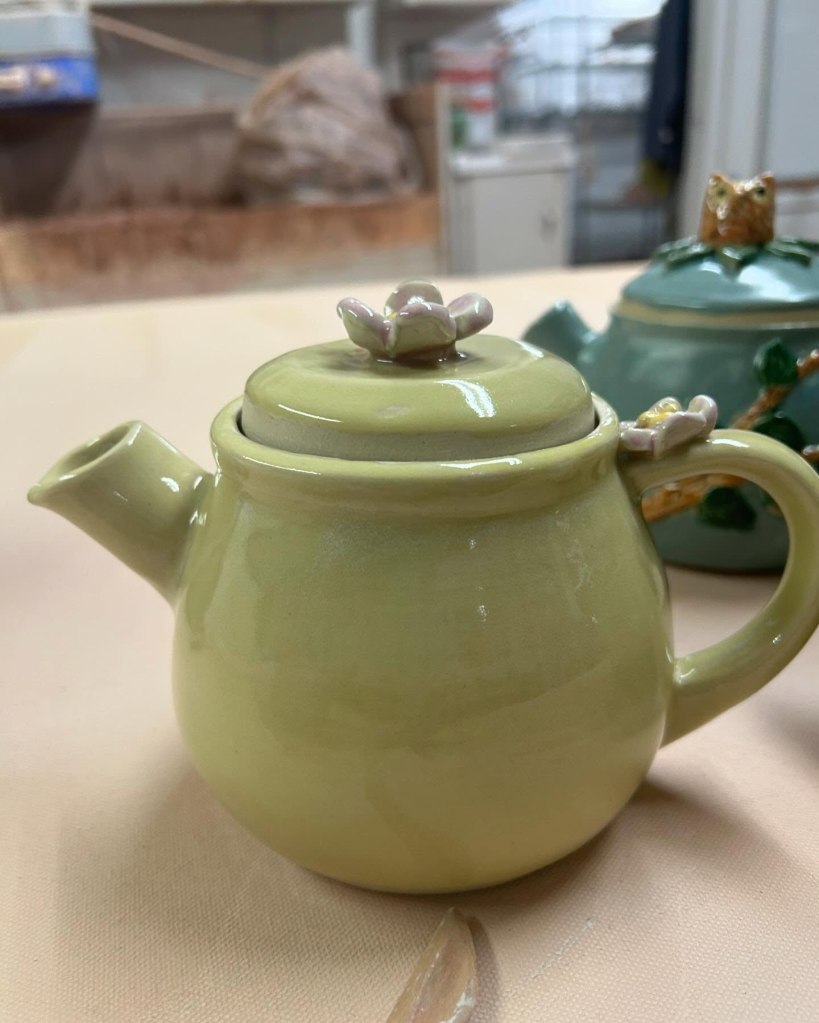
When everything came together for the first time, it was an absolute thrill. Until it came out of the glaze kiln. At which point the lid was slightly stuck to the pot–a fairly ordinary occurrence, I have since learned–and I had to take a rubber mallet to the pot to gently . . . GENTLY . . . try to unfuse the two pieces from one another. I’ve never been so aware of my powers of potential destruction in my life.
I’m happy to say that first teapot lived, and that I’ve since successfully made an array of teapots. But I’ll also say this: I will never again underestimate the ordinary teapot again in my life.

 Two Left Thumbs Pottery